OpenClaw, Beyond the Vibe: What Is It Really? (and Where the Real Value Is)
Now that the dust has settled and people have stopped panic-buying iMacs to run an AI assistant they didn't fully understand, we can finally have an honest conversation about OpenClaw — what it is, where its value really lives, and the use cases that almost nobody talked about during the hype cycle.

For about three months at the turn of 2026, OpenClaw was the conversation in tech. It went from a side project called Clawdbot to a renamed-twice GitHub phenomenon with hundreds of thousands of stars in a matter of weeks. The ecosystem got weird enough that OpenClaw agents used an AI-only social network Moltbook, which Simon Willison called the most interesting place on the internet. Fine, Simon — we get it. The vibe coders bought their Mac minis, set up their "personal AI assistants," and posted screenshots of their lobster bot scheduling lunches and remembering their dog's birthday.
And then, just as it peaked, the vibe was gone. The threads slowed down. The second wave of articles — focused on security, the "I tried it for 30 days" posts, the Hudson Rock report on a Vidar-variant infostealer that incidentally swept an entire OpenClaw configuration off an infected machine — started outpacing the hype. The hardcore vibe-coding crowd moved on to whatever shiny thing came next, leaving behind a much more interesting question:
What is OpenClaw actually good for, when you take the hype out of the equation?
That's what this post is about. Spoiler: the answer is not "a chatty assistant in your WhatsApp."
A brief bit of context for anyone who tuned out during the naming chaos: the project launched in November 2025 as Clawdbot, was renamed Moltbot in late January 2026 after a trademark complaint from Anthropic, and rebranded again three days later to OpenClaw — same project, three names in two months. In mid-February, creator Peter Steinberger announced he was joining OpenAI to lead their personal-agents division, and OpenClaw itself transitioned to an independent open-source foundation with OpenAI's backing. None of this changes the technical analysis below, but it explains why half the internet is still calling it by the old names and why the governance question matters more now than it did at launch.
The "Electronic Secretary" Framing Is Not Wrong — It's Just Boring
Almost every piece of OpenClaw evangelism in early 2026 sold the same idea: you message your AI in WhatsApp (or Telegram if you are one of the cool kids), it remembers your preferences, it pings you with a morning briefing, it logs your reflections into Obsidian at 8 p.m. Cute. Useful. Life-changing? Nah.
This framing is fine, really. It's also possibly the lowest-margin, lowest-leverage application of the platform (unless you are selling it and making a buck). A personal-assistant OpenClaw competes with: ChatGPT's memory feature, Claude's projects, your calendar app, your notes app, and the small army of mature productivity tools that already do 80% of the work without the security issues. If your job is to optimize your own life by ten percent, OpenClaw is a perfectly reasonable choice — but so is a Notion template, a recurring iPhone reminder, and many other services now provided by the likes of Anthropic and OpenAI.
The reason this is the framing that went viral is clear: it's the easiest one to demo in a 30-second video. "Look, my AI texted me." But "easy to demo" and "highest-value use case" are not the same thing, and the gap between them is where the real opportunities live.
Where the Value Actually Sits: Three Real Scenarios Use Cases
When you stop thinking of OpenClaw as a secretary and start thinking of it as a persistent, addressable, programmable agent runtime that lives on hardware you control, the math changes completely. Here are three examples that we have developed (with great results) at Euphrates.
1. A 24/7 Web Data Extraction Worker
OpenClaw can browse the web, execute shell commands, run scripts, and store results in local files — and it can do this on a schedule, on a webhook, or in response to a message, indefinitely, without you being in the loop. This is a data-extraction worker. A patient, polite, slightly-stubborn scraper that uses LLM reasoning to handle the messy stuff: layout changes, paywalls that move, anti-bot challenges, content classification, deduplication, normalization across heterogeneous sources.
The economics here are genuinely different from a hosted SaaS scraper. You pay for LLM tokens and a VPS (virtual private server). There's no per-record fee. The agent can read a job description, decide a site is irrelevant, and move on without burning compute on parsing. It can be told once, in plain English, "watch these 40 competitor pricing pages and tell me when something material changes," and it will figure out what "material" means in context.
If you've ever built a price-monitoring pipeline, a media-monitoring tool, a sales-prospecting engine, or a competitive-intelligence dashboard, you know that 80% of the engineering work is dealing with the long tail of source-specific weirdness. That's exactly the kind of work an LLM-driven agent absorbs gracefully.
2. A Persistent Developer (or Dev Team) That Doesn't Sleep
This one is less obvious from the marketing but has been hiding in plain sight: OpenClaw can be great at delegating engineering work to Claude Code, Codex, or any other coding agent — and managing those sessions across time and channels. Public testimonials have already converged on this pattern: an agent receives an alert from a production monitoring tool, opens the failing PR, runs the tests, writes a fix, and posts the diff back to a chat channel for human review. Then it goes back to sleep.
What's interesting here isn't that any one of those steps is novel — it's that OpenClaw is the glue that makes them happen unattended, with memory of prior incidents, in a place where humans already pay attention (their messaging app). For a small engineering team, this is the difference between "we'd fix that tomorrow" and "it was fixed at 3 a.m. and waiting for review at 9." For a larger team, it's the difference between paying a human to be on call and paying for tokens. If you are good at writing skills, there are even more opportunities here.
Multiply by n agents — one watching CI, one triaging issues, one running nightly benchmarks, one maintaining documentation — and you have a small autonomous dev team. Not as a replacement for humans, but as a layer of patient, never-tired second-shift work that the humans get to review and approve in the morning.
3. Long-Running Business Process Operators
Anywhere you have a process that is too judgment-heavy to hard-code as a workflow but too routine to need a human at every step, OpenClaw is interesting. Lead qualification with prospect research and CRM updates. Inbox triage where the agent drafts replies for review. Procurement: "watch these suppliers' availability and quote requests." Compliance monitoring: "scan our public statements against this policy doc weekly."
These are exactly the cases where deterministic workflow tools struggle — too many edge cases, too much "it depends" — and where pure chatbots fail because they don't run when you're not there.
The common thread across all three: value scales with autonomy, persistence, and reasoning per task, not with the number of cute notifications per day.
So How Does the Architecture Makes This Plausible?
A claim like "OpenClaw is well-suited to be an autonomous web-extraction worker or a 24/7 developer" only makes sense if the underlying architecture supports those workloads. It does. Here's the picture at a glance:
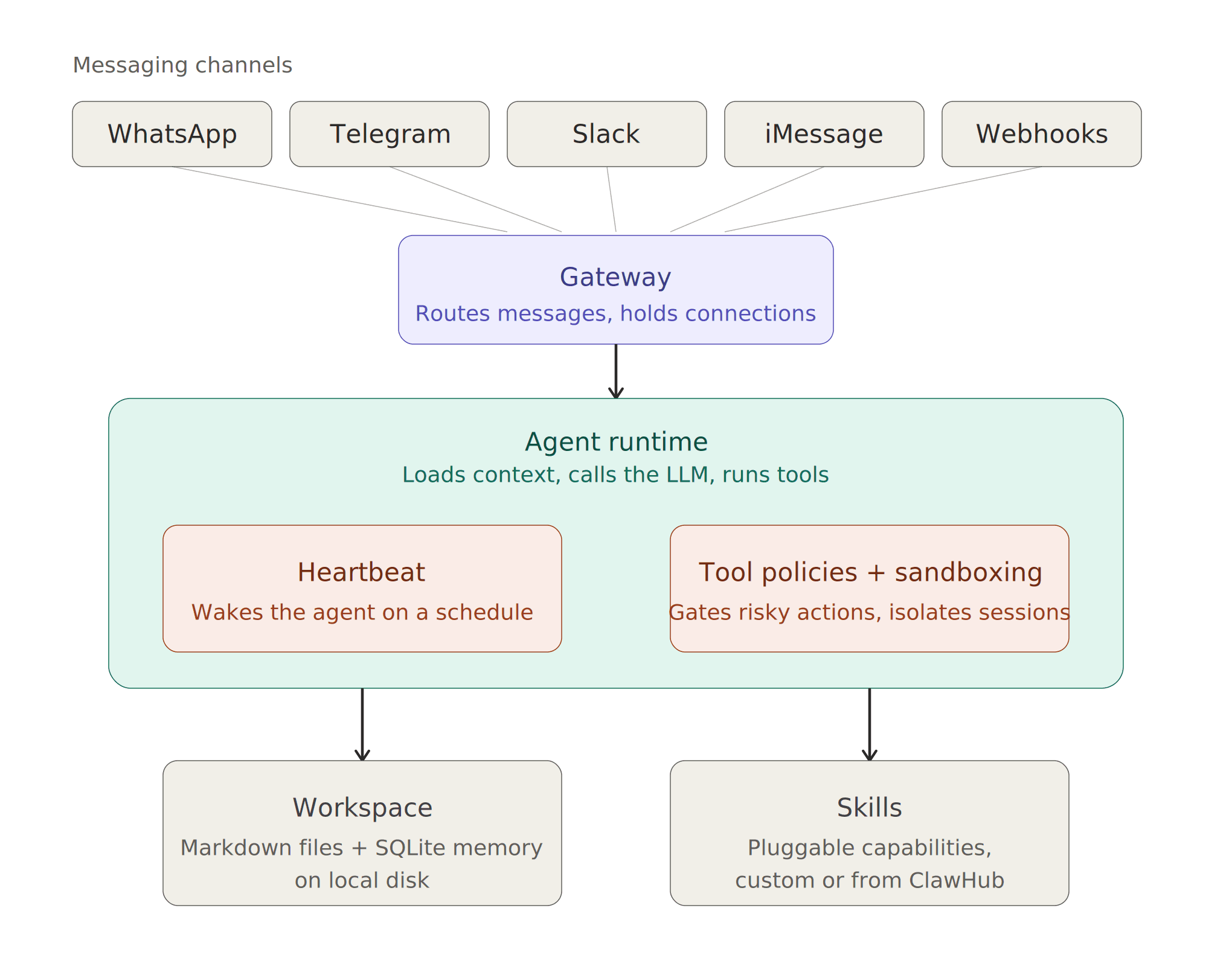
The Gateway. At its core, OpenClaw is a single Node.js daemon that binds to 127.0.0.1:18789 by default and acts as a central control plane. It manages connections to every messaging channel simultaneously — WhatsApp, Telegram, Discord, Slack, Signal, iMessage, and a long tail of others — and routes incoming messages to the appropriate agent session. Because it's a long-running process on hardware you control (laptop, homelab, or VPS), it has the property that hosted chatbots fundamentally lack: it can do things between your messages.
The Heartbeat. Every 30 minutes (configurable; once an hour by default when using Anthropic OAuth), the agent wakes itself up, reads a HEARTBEAT.md file in the workspace, and decides whether anything in there needs action. Cheap deterministic checks run first — pattern matches, simple API queries — and only when something has actually changed does the runtime escalate to a full LLM call. This is the architectural feature that turns OpenClaw from a chatbot into an operator. It can monitor things. It can act on schedules. It can wake up at 3 a.m. when a webhook fires, deal with the situation, and go back to sleep.
The Workspace and Memory Layer. Everything the agent knows about itself, its user, and its past lives on disk as plain Markdown files: SOUL.md (personality and rules), USER.md (you), IDENTITY.md (the agent's self-model), plus an evolving collection of notes and skill files. For semantic recall, a local SQLite database with vector embeddings stores past conversations so the agent can pull relevant context into the current turn. The fact that all of this is plain text on a local disk matters: it's auditable, greppable, backup-able with git, portable, and inspectable. Compare with hosted assistants where "memory" is a black box behind someone else's API.
Skills. OpenClaw's extension mechanism is a directory containing a SKILL.md with metadata and instructions, plus optional scripts. The catalog (ClawHub) has grown into the hundreds-to-thousands range. Skills can be bundled with the runtime, installed globally, or scoped to a single workspace, and they install without restarting the daemon. A complete skill can be implemented in roughly 20 lines of code — which is why the ecosystem moved as fast as it did. For the use cases we care about, this is the capability surface: any custom scraping logic, deployment script, or internal API client becomes a first-class tool the agent can reason about.
Tool Policies. High-risk actions are gated by configurable approval rules: read emails freely but require approval to send; read files but block deletions; allow shell commands inside a sandbox but not outside. You can dial autonomy from "asks me before doing anything" to "fully unattended," and you can do it per-skill.
The reason this architecture supports the use cases we listed earlier is that all three depend on three properties: persistence (the agent has to outlive any single conversation), reasoning per task (the agent has to make judgment calls, not follow scripts), and controllable autonomy (because you want it acting on its own most of the time, but not for the dangerous 5%). The Gateway plus the Heartbeat plus the Workspace gives you the first two; Tool Policies plus the local-first deployment gives you the third.
How Is This Different From n8n? Or From Claude Directly?
This is the question that determines whether OpenClaw belongs in a serious tech stack. The short answer is that OpenClaw, n8n, and Claude solve different problems, and the cleanest setups often use more than one of them.
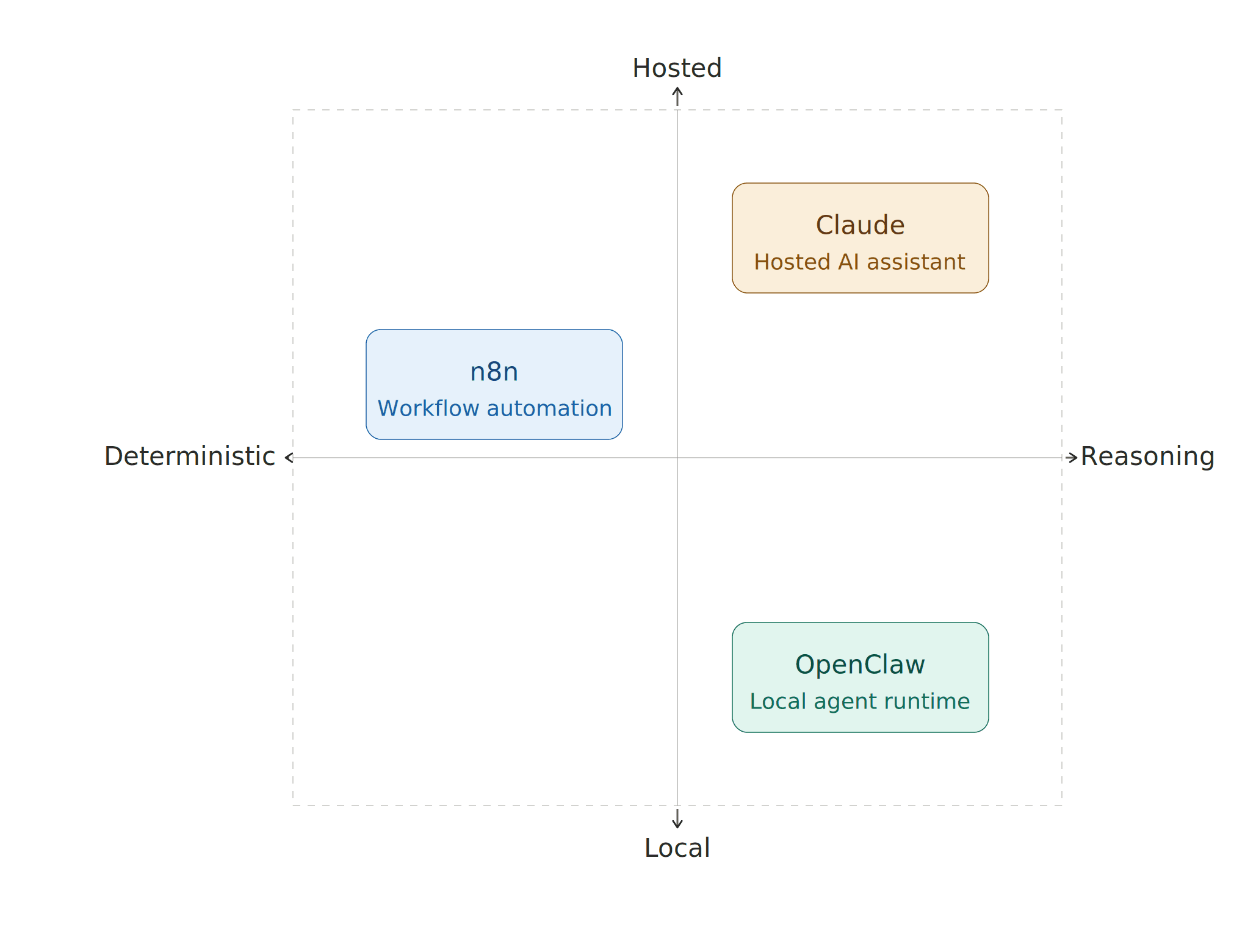
Place them on two axes — deterministic vs reasoning and hosted vs local — and the three end up in different corners. That spatial separation is the point: they're not competing for the same job.
Versus n8n
n8n is a visual, node-based workflow automation tool. You draw a flowchart: "when this trigger fires, run step A, then B, then C," and n8n executes it the same way every time. It has hundreds of integrations, a mature community, and is excellent at high-volume, deterministic, auditable processes — lead routing, invoice processing, data synchronization, scheduled reports.
The key word is deterministic. Given the same input, n8n produces the same output. That is a virtue when the process is well understood. It is a problem when the process requires judgment, because every edge case has to be modeled as another branch in the graph, and the graph eventually becomes unmaintainable.
OpenClaw is autonomous. Given the same input, it may choose different actions depending on context, memory, and the current state of the world. That is a virtue when the work is fuzzy. It is a problem when you need an auditable, repeatable pipeline.
The right framing — and most practitioners we respect have converged on this — is complementary, not competitive. Use n8n for the deterministic, high-volume layer where cost predictability matters. Use OpenClaw for the reasoning-heavy layer where judgment matters. They talk to each other via webhooks or HTTP. n8n triggers on an event, hands off a fuzzy decision to OpenClaw, and OpenClaw hands back a structured result for n8n to route. This is how sophisticated automation teams actually operate in 2026.
Cost note: n8n's cost scales with execution volume; OpenClaw's cost scales with LLM tokens consumed. For thousands of structured runs per month, n8n is cheaper. For dozens of reasoning-heavy runs per day, OpenClaw is cheaper and substantially more flexible.
Versus Claude (or any hosted assistant)
This is the comparison that gets confused most often. Both Claude and OpenClaw can talk to you, reason about tasks, and use tools. So what's the difference?
Claude is a model and a hosted product. When you use Claude via the chat interface or the API, you are talking to a model running on Anthropic's infrastructure, with whatever context window and tool integrations the product exposes. Claude is genuinely excellent at reasoning, writing, and using its built-in tools, and for most of what users want from "an AI assistant," it's the right answer.
OpenClaw is not a model. It's a runtime that uses models — Claude, GPT, Gemini, DeepSeek, local Ollama models, whatever you point it at. The intelligence is borrowed; the orchestration is local. The differences that matter in practice:
- Where it runs. Claude runs in Anthropic's cloud. OpenClaw runs on your hardware (or a hardware that you manage yourself, nothing forbids you from running it on GCP/AWS). For regulated data, internal systems, or anything where you want to keep secrets and context off third-party servers, this is decisive.
- Persistence and proactivity. Claude responds when you message it. OpenClaw lives 24/7 on a Heartbeat and can act unprompted. This is the architectural reason OpenClaw can be a "worker" while Claude is an "assistant."
- Tool surface. Claude has the tools Anthropic builds in. OpenClaw has whatever skills you (or the community) write — including arbitrary shell commands, browser automation, custom APIs, hardware control. The freedom is real, and so is the risk.
- Cost structure. Using Claude directly is metered API. Using OpenClaw is metered API plus infrastructure plus the cost of running and securing the host yourself.
For end-users who want a thoughtful chat partner, Claude is the right tool. For a team that wants to deploy autonomous workers against real systems, OpenClaw is the more capable platform — and it will most likely be calling Claude (or another frontier model) under the hood anyway.
Some Honest Last Lines
OpenClaw deserved much of the attention it got, just not for the reasons it got it. The "personal assistant on WhatsApp" framing is the consumer-app demo, the part that fits in a tweet. The real platform underneath is something more interesting: a local-first agent runtime with persistence, scheduling, a community skill ecosystem, and enough configurable autonomy to operate unattended against real systems. That platform is well-suited to web-scale data extraction, autonomous developer workflows, and judgment-heavy business processes — the kind of work that historically required either a small team or a fragile pipeline of brittle scripts.
The risks are real and worth respecting. Misconfigured instances have leaked credentials; prompt injection remains an industry-wide unsolved problem; researchers found over a hundred thousand exposed OpenClaw instances reachable from the public internet at one point. None of that is a reason to dismiss the platform. It is a reason to deploy it the way you would deploy any other privileged automation: sandboxed, least-privilege, with tool policies that gate dangerous actions and with audit logs you actually read.
Used as an electronic secretary, OpenClaw is a clever toy. Used as the autonomous-work layer in a stack that also includes n8n for deterministic flow and Claude for high-reasoning chat, it's a genuine competitive advantage — and one that almost nobody is fully exploiting yet.